
As a child, she had constant and often excruciating ear infections, along with frequent respiratory infections. Whenever she got sick, it seemed to take her much longer than everyone else to recover. She would be unwell for days, sometimes weeks, and the illness often seemed to linger long after everyone around her had moved on.
“There was always the same cycle,” Lily says. “I’d get sick, get really sick, start to feel okay, and then it would linger – mostly as a bad cough that would last for weeks.”
As she got older, the pattern continued. Illness seemed to follow surgeries and procedures, and respiratory infections became a familiar part of life. Five years ago, Lily coughed so severely that she fractured a rib.
“Everyone around me would get sick and be run down, but they would bounce back,” she says. “For me, I would be fully bed-bound for at least a week.”
At the time, Lily had no idea there could be an underlying reason. Looking back now, there had been clues along the way.
Around ten years ago, Lily donated plasma. As someone with the universal plasma donor type, she was encouraged to donate plasma rather than whole blood. After one donation, she received information about her blood results showing she had an undetectable level of IgA. Lily mentioned it to doctors from time to time over the years, but it wasn’t until much later that the significance of that result became clear.
By 2025, her health had become increasingly difficult to manage. She developed pneumonia and was sick at least six times throughout the year. Over Christmas, she caught RSV and was too unwell to attend her family gathering, with her partner video-calling her into the celebrations instead.
Eventually, Lily was referred to a respiratory specialist. She mentioned her old blood results, and this led to a referral to an immunologist. Further testing showed she had no detectable IgA and that her immune system was not responding to vaccines as expected.
At 28 years old, Lily was diagnosed with Common Variable Immunodeficiency (CVID).
The diagnosis brought mixed emotions.
“There was relief because I finally knew it wasn’t just in my head,” Lily says. “But there was also fear. You think, ‘What do you mean I have to do this forever?’”
For Lily, the diagnosis suddenly helped explain a lifetime of unanswered questions.
“There is a real benefit of hindsight,” she says. “You only know what you know at the time. Looking back, so many things started to make sense.”
In February 2026, Lily began monthly IVIg treatment at the Royal Hobart Hospital. The difference has been remarkable.
Since starting treatment, she has only been sick once – something she says is almost unheard of for her. Even then, the illness did not knock her around in the same way it would have before, and her recovery time was much shorter.
“Normally by August, I would have had at least three respiratory infections. This year has been completely different,” she says. “It has been absolutely life changing. I didn’t realise how much better life could be before I started treatment.”
The first few months were still an adjustment. In the week leading up to her next infusion, Lily often experienced crushing fatigue. But over time, that has become more manageable, and life no longer feels like the same constant uphill battle.
For Lily, having a diagnosis has also changed the way she can advocate for herself.
“Before, I felt like I had to fight so hard to be taken seriously,” she says. “Now I can say, ‘I’m immunocompromised. These are my symptoms, and I need treatment.’ Having a diagnosis means I can explain what I need.”
There is another part of Lily’s journey that makes her treatment especially meaningful. Before her diagnosis, she was a plasma donor herself. Now, because of her CVID, she is no longer eligible to donate. Instead, she receives a treatment made possible by the generosity of plasma donors.
“I used to donate plasma when I could,” Lily says. “Now that I can’t donate anymore, I want to bring together the people around me and encourage them to donate if they can.”
IVIg is a plasma-derived treatment, and Lily will need regular infusions for the rest of her life. Knowing that her treatment is made possible by people choosing to roll up their sleeves and donate has given her a deep appreciation for the life-saving power of plasma.
She is still learning what life with CVID looks like. Lily now wears a mask on public transport and in shared transport spaces, carries hand sanitiser with her everywhere and takes extra precautions to reduce her risk of illness. Her family also understands the risks and gives her space when they are unwell.
But her diagnosis has not changed the things that bring her joy.
Travel has always been a big part of Lily’s life. While studying at university, she spent time teaching English in France as a teaching assistant. She loves adventure, discovering new places, experiencing different cultures and trying new food.
She has not travelled overseas since her diagnosis, but it remains something she hopes to do again.
For now, Lily is taking time to adjust to this new chapter. She graduated in 2022 with degrees in Arts and Law, majoring in French and community law. She is currently taking a break from work to focus on her health and reset, while considering her next steps.
When she was first diagnosed, Lily was fortunate to have a proactive immunologist who referred her to IDFA. Accessing information and connecting with the wider community helped her realise that she was not alone and that her experiences were real.
For others at the beginning of their own journey, her advice is simple.
“Be kind to yourself,” she says. “It’s a big life adjustment. Give yourself space to process it and adjust. If you need to take away other demands or put accessibility measures in place, that’s okay.”
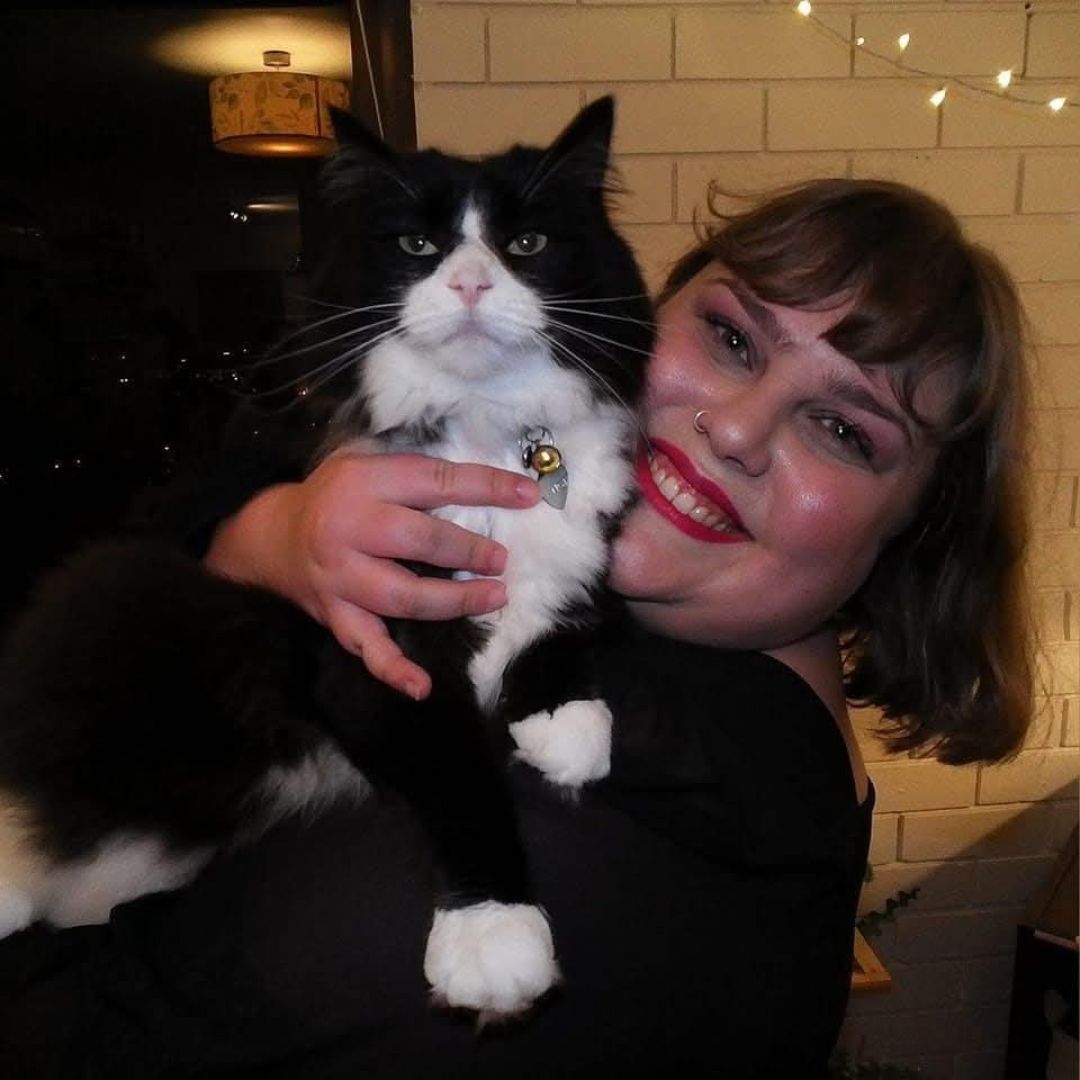
And through every stage of her journey, Lily has had one very special companion by her side – her 12-year-old black and white cat, Angel.
“He has been there through it all,” Lily says. “When I’ve been sick, he seems to know. He just comes and cuddles up to me.”
Today, Lily is still adjusting and still learning what life with CVID will look like. But she now has answers, treatment and a community around her.
And every month, when she receives her IVIg infusion, she is reminded of the strangers who choose to donate plasma – people she may never meet, but whose generosity is helping her get her life back.
For Lily, that generosity has changed everything.